Your Guide to Our Crime Classics
13 September 2012
Crime fiction has always evaded categorisation, continually
evolving into new and ever more sophisticated forms. But one things
remains true: from the Golden Age of detective fiction in Britain
to the mean streets of American (and British) noir there has always
been something for everyone.
In The Murder Room, we've tried to make it
a little easier for you to find what you're looking for and
discover new delights. Here Barry
Forshaw offers a guide to the categories we've
used.
The Detective Novel
The iron grip on readers' affections that the detective novel
maintains is seemingly unshakeable. In Britain, Charles Dickens and
Wilkie Collins were early begetters, inaugurating key facets of the
genre - tenacious, strong-willed detective, complex plotting,
surprising revelations. Later, Sir Arthur Conan
Doyle - whose Great Detective, Sherlock
Holmes, was modelled on the American Edgar Allan Poe's
super-intelligent detective Auguste Dupin - added rich layers of
the eccentric characterisation and accoutrements that have made
Holmes one of the best-known figures in fiction. And the form
flourishes to this day, exploring the geographical possibilities of
the British Isles, the vast canvas of the United States and
virtually every other point of the compass.
The very parochialism of much British detective fiction is
precisely what imbues it with its customary sharpness: when
murderous secrets are confined within restricted suburban spaces,
the explosive effect, when unleashed, is that much more seismic.
The genre is particularly satisfying in that we are invited to
relish the chaos wrought by crime and criminals before the status
quo is re-established by the detective figure.
In terms of specifically generic fiction, the denizen of 221b
Baker Street and his celebrated creator have of course, spawned an
army of imitators - notably Agatha Christie's Hercule Poirot - and
Holmes clones continue to surface to this day, dressed in
contemporary garb rather than deerstalker and Inverness cape.
The most striking fact about the best detective crime writing is
the craftsmanship and invention that inform the work of so many of
its practitioners, and whatever the social background of the
detective, or his or her predilection - the bottle has long been a
staple ingredient - the sudden leap of deductive logic or
inspiration is as much part of the sleuth's armoury as it ever
was.
There is, too, the tradition of social commentary that has
always been a key element in the genre - though rarely at the
expense of sheer storytelling skill - the single attribute of
crime-writing that, above all, has seen it occupy its
incontrovertible position in the early twenty-first century as the
most popular of popular genres.
The Noir Novel
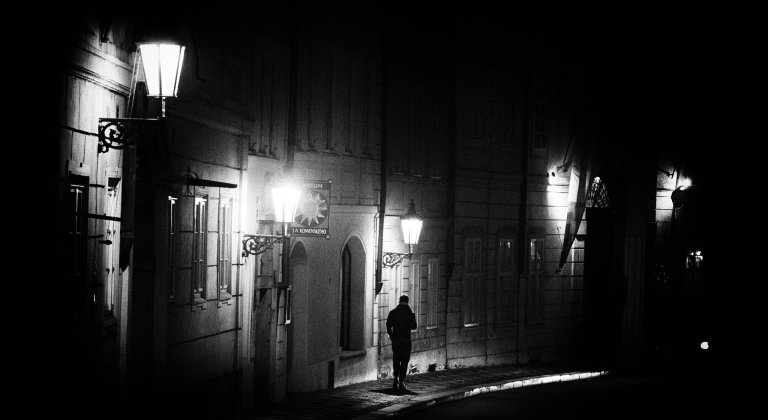
Rainswept streets. Darkened rooms where dark deeds are done. And
the darker, unfathomable recesses of the human psyche: all of these
are the territory of the noir novel. The menacing universe of
shadows and murder through which the characters stagger is a
correlative of their benighted, often tragic state. Reading such
books is rarely a comfortable experience - but always an utterly
compelling one.
The new, shadowy vision of the world that followed the Second
World War was peopled by end-of-their-tether, solitary characters,
encountering bloodshed and death. British noir received its
inspiration from the lurid pulp magazines that first featured
American hardboiled fiction and were avidly consumed in the UK. The
flawed protagonists who inhabit the dangerous world of these novels
- often American, but with a strong British contingent -
customarily sport the authors' jaundiced take on the human race,
where people are often driven to murder, and overwhelming guilt, by
the irresistible demands of sexual passion or greed (or both). In
the noir novel, we are given a mesmerising, if uncompromising,
vision of the lawless actions of which many of us, in extremis,
might be capable.
Noir, both British and American, was the perfect literary
expression of the new Age of Anxiety, and it speaks to readers in
the twenty-first century with quite as much power and persuasion as
it did to its original audience. What's more, the concentration on
the tortured psychology of the characters - as much as on the fatal
consequences of their actions - now seems extremely modern. What
was once just one offshoot of crime fiction has now become
virtually standard, demonstrating readers' need to make sense of a
world where life may be cheap, but a price has to be paid. Of all
the varied byways of crime fiction, the noir novel has arguably
been the most influential, and its dangerous progeny continue to
appear to this day.
The Thriller
The thriller - the novel of suspense - remains one of the most
durable of fictional forms, and is in rude commercial health in the
early twenty-first century. But the genre would not exist in the
form it does today without some remarkable writers who forged - and
finessed - its various excitement-generating elements in the
past.
Of course, until recently there had been a certain snobbery
connected with the thriller; after all, how could something so
diverting have any literary gravitas? These days the situation is
markedly different. Admittedly, certain thriller writers from the
last century achieved great critical acclaim, notably such talents
as Eric Ambler; but more and more critics are now showering as much
praise on the sheer quality of writing to be found in this tense
and kinetic form as on its less pulse-raising crime-fiction
bedfellows, in which bloody-minded coppers doggedly solve
crimes.
The thriller does not just take one form, however. Essentially,
it can be divided into two principal categories: in the first, the
adventure thriller, the protagonist is frequently thrown into
life-threatening situations; these novels do not fall into the
category of straightforward crime, detective, legal or police
procedurals, and are lean and muscular shockers (as they used to be
called), which sport a picaresque, sometimes international element
with an emphasis on action and danger. This genesis of this type of
thriller could be said to have begun with John
Buchan's The Thirty-Nine Steps and continued
through Frederick Forsyth's Day of the Jackal, up to
such modern-day thriller writers as Gerald Seymour and those
novelists who specialise in books featuring special forces
operatives and similar hard-as-nails protagonists.
But there is another equally compelling form of thriller: that
which trades in more subtle psychological suspense, with a central
character (usually female) under a less clearly defined threat,
often in mind as much as body. Classic examples include the novels
of Joan
Fleming and M. M.
Kaye's Death in . . . series and (perhaps the prime
example), Daphne du Maurier's matchless Rebecca, with
its nameless heroine unable to turn to anyone to alleviate her
ever-growing fear.
Detractors sometimes take a reductive approach to the form,
suggesting that thriller writing is bound by its self-imposed
rules. But the best practitioners of the genre know exactly how to
ring the changes on the conventions (such as the spy framed and
ruthlessly hunted by his own side or the woman under threat from
those closest to her). And, let's face it, we love these
conventions - they satisfyingly lay out the ground rules for us, so
we are ready for our wild ride. We may be on the edge of our seats,
but, paradoxically, there's nothing as relaxing as a thriller that
grabs us by the throat and won't let go.